Why You Can’t Relax With Dystonia (No Matter How Hard You Try)
Oct 12, 2026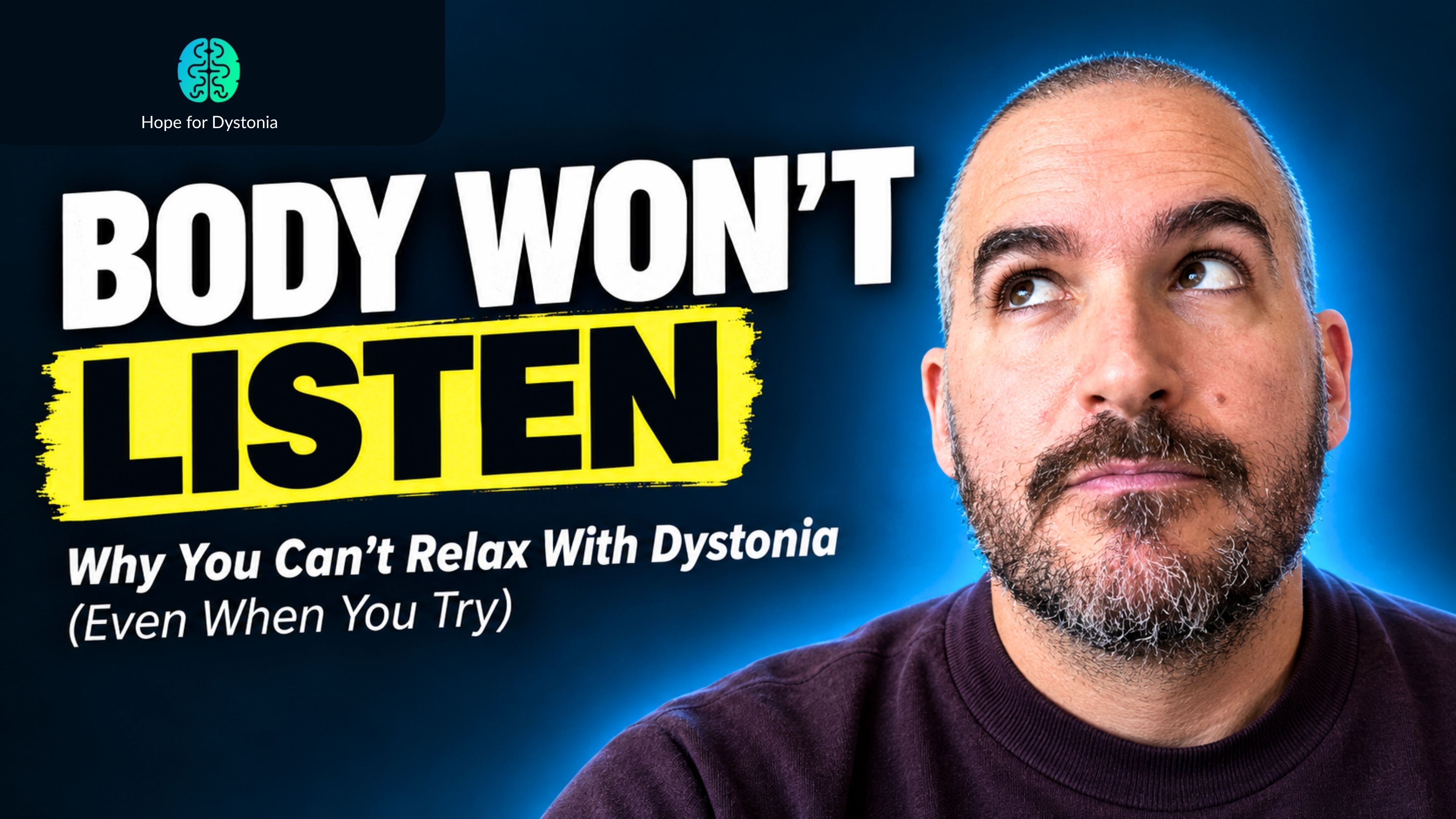
This article is based on a video from the Hope for Dystonia YouTube channel.
For a long time, I would try to relax my jaw, my neck, the parts of me that dystonia had taken over — and I simply couldn’t. I’d massage the tension, try to will it away, and it wouldn’t move. That feeling of being trapped in a body that won’t cooperate kept me stuck in frustration for years, until I finally began to understand what was actually happening — and why everything I’d been trying hadn’t worked.
If you’ve ever tried to relax a part of your body affected by dystonia and realized you simply can’t, this article is for you. I know how frustrating that is, and how oppressive that feeling of being trapped can be. I want to talk about why we can’t relax with dystonia even when we try so hard, why the things you’ve tried may not have worked, and what you can do instead.
Watch the Full Video
The Feeling of Being Trapped in a Body That Won’t Cooperate
There’s a very specific experience shared by everyone who deals with dystonia: the feeling of being trapped in a body that won’t cooperate. It comes with profound frustration, grief and anger, and so many complicated feelings — the realization that there’s tension we try so hard to get rid of, to massage away, to release, involuntary movements we desperately want to move away from, and we apparently just can’t.
It’s shocking, because being unable to feel normal in your own body is not a possibility on anyone’s bingo card growing up. I was trapped in that frustration for a really long time before I cracked the code on what was happening in my body. If you’ve seen a few of my videos, you know that for a long time I had a hard time speaking, chewing and walking. That progressive limitation of my life was really, really tough, and I understand how maddening it is to want dystonia to be different, to want it to go away, and to watch it refuse to change just because you want it to.
The Pattern Was There Long Before the Dystonia
Over time, I learned to work with my nervous system differently — and it started with a simple piece of self-inquiry. Let me invite you to try it now. Take a deep breath into your belly, exhale, and relax. Then look honestly at your own patterns: what do you do when you get stressed? When the dystonia is at its most frustrating, do you try to control it, to fix things? When you’re under pressure, do you try to make sure everyone around you is happy, so that maybe you’ll finally get a chance to relax?
Notice how, more often than not, this isn’t new. It’s not something you started doing with dystonia. It’s something you’ve been doing for much longer — one of the main ways you learned to feel safe and to cope with the difficulties of life. Maybe you’re the one everyone counts on, the one who always puts yourself last. Maybe you’re the one who’s always on top of everything, so vigilant that nothing dangerous ever gets to disturb the peace. Maybe you’re so attuned to everyone around you that you always know what they’re feeling and thinking, and you cater to all of their needs — and end up feeling that no one takes care of you, that there’s no time for you.
These patterns are crucial. They are not a detail. They are expressions of the very same chronic dysregulation of the nervous system that is, in many ways, at the root of dystonia. It doesn’t have to be the sole cause, but it sits right there at the heart of how it all starts: a pattern of chronic dysregulation — agitation, freeze, fawn, fight or flight — that we adopted because, at some point, it made sense. And usually it first made sense when we were young.
“You Don’t Get to Relax Until…”
The more we practice these patterns, the stronger they become. We work ourselves up trying to pre-empt every danger, to please everyone around us, to be stronger than our difficulties — and every time, we deepen the patterns that quietly insist: you don’t get to relax. You don’t have a right to relax until you prove you’re good enough. Until everybody’s happy. Until the to-do list is finally complete.
Through neuroplasticity, those patterns of tension and guarding become more and more the default of how we exist in the world. And then we start to fear they’re permanent — that something went wrong inside us, and this is simply how we’ll be forever, with that spasm, that tension. So what do we do? We try to monitor ourselves, to catch ourselves, to manipulate our muscles, to impose some sort of correct posture. I used to constantly try to organize my face and my body, trying not to make my symptoms — or the fact that I was struggling — too obvious. It’s exhausting. We end up watching ourselves from the outside, at the expense of simply being present for the life we have. And this is not what leads to healing.
There Is Wisdom in the Spasm
What I want to propose instead is something different. The spasms, the pain, the contractions, the involuntary movements — they have wisdom. They offer us a window into all the ways we’ve learned to protect ourselves, all the ways we’ve learned that it is not safe to let go, not safe to trust, not safe to soothe ourselves, not safe to come into regulation.
Once we understand what the pain and the spasms are telling us, we have an opportunity to work with that wounding — with the parts of us that believe we have to work hard, to constantly protect ourselves, to stay guarded. And we don’t work with these wounded parts by disciplining them into doing something different. We work with them by nurturing them — by offering them love and care, in a way that lets them understand that the guarding isn’t necessary anymore, so that little by little we can let go, more and more, into trust.
Your Brain Is a Snow-Covered Mountain
Here’s a metaphor you may have heard me share before. Think of the brain like a snow-covered mountain, and our movements, thought patterns and ways of existing in the world like skis. The more we ski down a certain slope, the deeper the grooves become — and the harder it is for the next skier to escape them.
That frustrating experience of “why can’t I just let go of this spasm?” is the skier getting stuck in the existing grooves. The process of neuroplasticity, of recovery, of healing, is all about learning to ski down a different slope. At first those new grooves are very shallow, and you’ll have a hard time finding them — especially when the visibility is poor, when you’re triggered and life is throwing challenges at you. But you can train yourself to find those faint new marks. That is the real work.
When Was the Last Time You Could Just Be Yourself?
So let me leave you with a question to sit with. When was the last time you felt you could just be yourself — exactly as you are — and that you didn’t need to fix anything or manage anything, didn’t have to keep everybody else happy, didn’t have to white-knuckle through? When was the last time you felt, ah, I can really, deeply let go and relax? That feeling is what we’re after.
Whatever comes up as you ask yourself that is appropriate, relevant and helpful. Maybe voices appear — “but I’m supposed to do this, I can’t possibly just be myself.” Maybe objections, or grief that you haven’t been able to live this way. All of it is a window into the inner landscape, and into the infrastructure we’ve built that tells us we need to stay guarded. The upcoming free workshop is an opportunity to come into our hearts and work on exactly this — giving ourselves permission to try on a new pattern, a new way of being ourselves that allows for deeper relaxation and a sense of okayness, the kind that, in time, allows for learning and recovery.
You Are Not Merely a Victim of Dystonia
I know how baked-in these patterns can feel, how immutable, how sad and maddening. If you’ve read this far, you’ve probably already been through a lot. So I want to encourage you to believe in a possibility — not the possibility of miracles, or of someone fixing your dystonia with the snap of a finger, but the possibility of learning. Of getting to know yourself. Of understanding what your body, your psyche and your nervous system actually need, so that you can learn to provide it, little by little. And little by little, the nervous system can try on new patterns — maybe only for a tiny moment at first. But that tiny moment is a window into your agency, into your power.
You are not merely a victim of dystonia. You have the possibility to learn, to understand yourself better, and to begin shifting things around. That is a gift this recovery process can give you — one that is far bigger than the dystonia itself.
Your Next Steps
There are two free resources that pick up exactly where this article leaves off:
1. The free Dystonia Recovery Kit. Information that completely reframes how you understand dystonia and begins to show you how to turn it around.
2. The free workshop — Dystonia and Your Childhood: Releasing Chronic Guarding. Our upcoming live workshop goes deeper into these patterns of chronic guarding — where they come from, and how to begin unlearning them.
Prefer to go deeper live? Save your spot in the free workshop →
Dystonia and Your Childhood: Releasing Chronic Guarding
Sunday, November 15, 2026 · 12:00 PM EST / 9:00 AM PST / 5:00 PM GMT
No cost, no catch — just a new way of understanding your body. Much love to you, and I hope to see you in the workshop.
You can do this.