The Vagus Nerve and the 4 States Behind Dystonia
Sep 10, 2026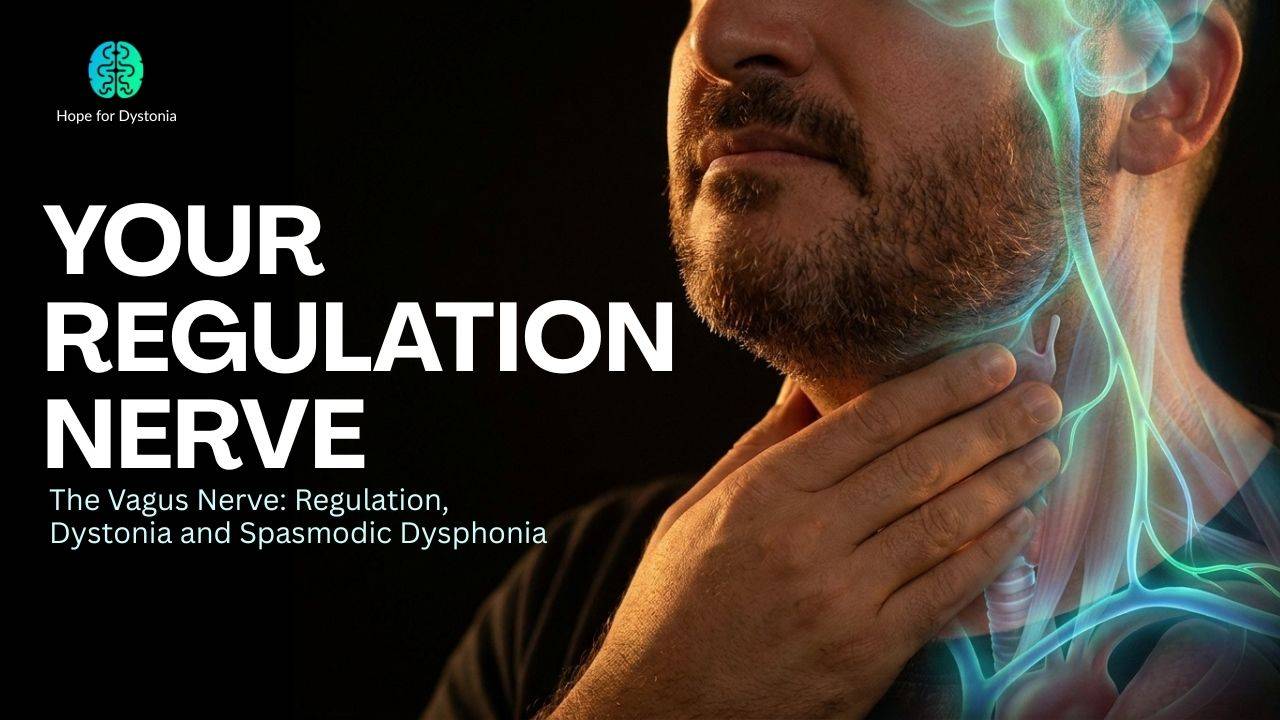
This article is based on a video from the Hope for Dystonia YouTube channel.
For years, I lived stuck between states my body couldn't get out of — frozen when I needed to act, bracing when there was no real danger, and at my lowest, collapsed and sure that nothing I did would ever matter. I know now that none of it meant something was wrong with me. It meant my nervous system was doing its best to keep me safe. Understanding the vagus nerve is a big part of how that changed.
Everyone talks about the vagus nerve, so I usually talk about it less. But it's worth looking at from a specific dystonia perspective. This is especially relevant if you have spasmodic dysphonia — spasms that affect the voice — but the patterns we'll cover are ones that everyone with dystonia has experienced in one way or another. Many of us get stuck in them, or swing between the extremes.
The vagus nerve is cranial nerve ten. It connects an enormous number of functions in the body, and today we'll look at two things: its motor role in the voice, and the four states it helps regulate depending on what your body senses around you.
Watch the Full Video
The Voice: Cranial Nerve Ten's Motor Role
The motor function of the vagus nerve governs voice production and the larynx — how we express ourselves out loud. It's what's most affected in spasmodic dysphonia, but it's also an expression of something much bigger, which we'll come to.
You can sense this side of the vagus nerve. Notice if there's an imbalance in how you speak, more action on one side than the other. You can also look at your soft palate: if your uvula — the little bell at the back of your mouth — is being pulled more to one side, with more tension on one side of the soft palate than the other, that may be showing you that you're overusing one side and underusing the other.
In the Academy, we learn to work with these imbalances — inviting the body to try on a new way of using cranial nerve ten, one that allows for more symmetry. And we don't usually do that by working on the vagus nerve directly. We work with the whole ecosystem of cranial nerves, because they function together. Waking up the sleepy parts and letting go of the overused ones is important work, especially with spasmodic dysphonia. But it's only one part of what the vagus nerve is about, and what recovery asks for.
The Bigger Picture: 4 States Your Vagus Nerve Regulates
The vagus nerve doesn't act on a whim. Depending on what your body perceives in the environment, different reactions happen — and cranial nerve ten helps facilitate several of them. There are four states that are crucial to understand if you live with spasmodic dysphonia, dystonia of any kind, chronic dysregulation, or the effects of trauma.
1. Ventral vagal — the state we want more of
This is the regulated state that allows for social engagement — speaking, expressing ourselves, staying settled in the presence of others. It's how you feel over a good meal with friends: connected, laughing, not anxious about what to say or how you're coming across, present and going with the flow, not organizing around a threat.
Being here depends on actually being able to feel safe in the first place. If you've experienced a lot of developmental trauma — as many people with dystonia have — you may have learned not to trust this state, to contract and tighten around the very possibility of safety. If the ventral vagal state is hard to access, it may be because something deeper wants to heal. Part of the work is providing the body new messages, so the whole system can slowly organize differently, in its own time.
2. Fight or flight
When vagal tone lowers, we organize around fighting or fleeing a perceived threat. It doesn't have to be a tiger — it can be an emotional threat: a lack of safety in our environment, or the belief that we have to manage everyone's emotions in order to finally feel okay. In this sympathetic activation, digestion slows, the heart rate can rise, muscles tighten, and there's a sense that something urgent and burning is happening. Many people with dystonia get stuck here easily — it's a tendency of mine, too. If we've learned that keeping everyone happy is how we avoid being yelled at, we keep doing it.
3. Defensive immobilization — the first kind of freeze
Most of us know fight, flight, freeze. Freeze actually splits into two. The first is defensive immobilization: a mix of sympathetic and parasympathetic reactions that produce a deer-in-the-headlights moment. You're rigid, you don't blink, and inside you're panicking — you feel you should be doing something to fix this, but somehow you can't move, and the car keeps advancing toward you. I've experienced this a lot, far less now after much work on it. And I've seen it in so many people with dystonia. We can end up telling ourselves we're lazy or not hardworking enough, that something is wrong with us. But we're not lazy. We're traumatized. And this is a state the vagus nerve and the whole polyvagal system are deeply involved in.
4. Shutdown — the collapse
The second kind of freeze is shutdown: the dorsal vagal collapse. Very little energy, can't move, can barely get out of bed. Many of us with dystonia have been through this or get stuck in it. It's not your fault. In shutdown, it can feel like nothing you do will ever have any impact — like you're a victim who can't do anything that matters, and you lose your sense of agency.
This one we can work with directly. Little by little, we find small pieces of agency and notice: I may not be able to change everything right away, but I do have power here. If shutdown is prevalent for you, the invitation is to find the little things that make a 5% difference. In the Academy, especially in our group coaching, a big focus is finding those small moments of agency — and it's amazing how contagious it is. When one person recognizes their own agency, others begin to see it too: "when I do X, my nervous system responds with Y — so I guess I have some power here." That's often how we start to come out of shutdown.
Why This Matters for Dystonia
In dystonia, these reactions can get stuck — and stuck in surprising ways. Some parts of the body may be going at it, preparing for a big fight, while others feel frozen, forgotten, and shut down. The patterns we notice in the body are an expression of patterns we carry within. That's a key insight behind the Academy.
We can and should work directly with the motor patterns, the spasms, the overused and the sleepy nerves. But that isn't enough if the body doesn't trust that a new, more regulated state can be maintained — which is why the inner work matters. We want both the inner and outer state to move toward trusting regulation, not because we force it, but because we create the conditions for the body to organize differently. Learning to recognize these states lets us have an honest conversation with ourselves instead of the automatic "I'm fine." And that honesty is a beautiful starting point for change.
You Can Do This
This path of empowerment is what we teach and practice in the Academy. You don't need to wait for a savior to fix you. You learn to listen to the parts of you that are hurting, understand how your body learned to organize itself, and provide it new messages so it can slowly shift. You are the direct recipient of all the messages your body is sending you — and you can learn to read them.
Your Next Steps
Two free resources pick up exactly where this article leaves off:
1. The free Dystonia Recovery Kit. The foundational information I wish someone had handed me when I was in the thick of it.
2. The free workshop. Our upcoming live workshop goes deeper into the cranial nerves and this nervous-system work — and shows you what the Self-Healers Academy is really about.
Want to go deeper live? Register for the free workshop →
No cost, no catch — just a new way of understanding your body. Much love to you. In the meantime — you can do this.