3 Essential Tips for Cervical Dystonia Recovery | Hope for Dystonia
Jul 27, 2026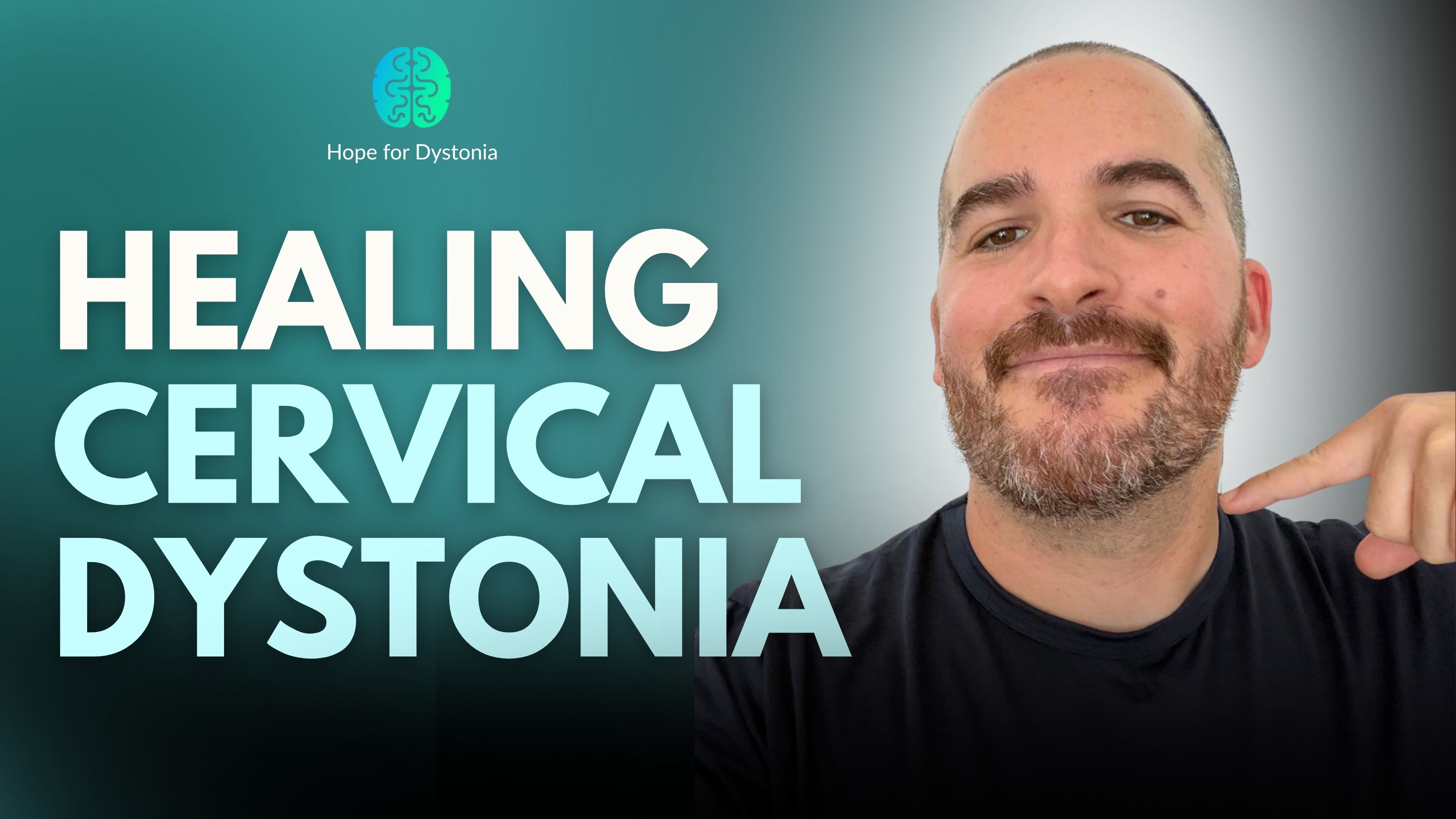
This article is based on a video originally published on the Hope for Dystonia YouTube channel.
If you're living with cervical dystonia—or suspect you might have it—I want you to know: I get it. It's a lot. The visible nature of it, the way it interferes with daily life, the confusion about what's actually happening and whether you can do anything about it.
But I also want you to know: this is not the end. This is a beginning.
If you choose for your dystonia healing journey to be an opportunity for growth, it will lead you beyond what you may have ever imagined. It will help you heal in ways you didn't even know were possible.
Here are the three essential tips that can save you years of frustration and help you actually get better—not just mask symptoms.
Watch the Full Video
Three Essential Tips for Cervical Dystonia Recovery
Why Cervical Dystonia Deserves Special Attention
Cervical dystonia is one of the more common forms of dystonia, and it's particularly challenging because:
- It's often visible — others can see when your head is pulling or tremoring
- It interferes with daily function — driving, working, socializing all become difficult
- It can feel mysterious — why is this happening? What's actually going on?
Understanding what cervical dystonia really is—and what it isn't—changes everything about how you approach recovery.
Tip #1: Practice Mindfulness and Self-Compassion
Cervical Dystonia Is Not About the Neck
This is perhaps the most important thing to understand: cervical dystonia manifests in the neck, but it's not about the neck.
It is, in fact, a form of guarding. A form of protection.
The spasm, the involuntary movement, the unnatural position you find yourself in—these are expressions of how your nervous system has learned to protect itself based on the inputs it received from very early in life up until now.
The Typical Pattern:
| Phase | What Happens |
|---|---|
| Early years | Various inputs teach the nervous system certain protective patterns |
| Patterns lurk | These guarding patterns exist below the surface, not yet causing obvious symptoms |
| Acute event | A shock or stressor causes the nervous system to feel it can't hold things together the same way |
| Doubling down | The body intensifies the protective patterns that were already there |
| Cervical dystonia emerges | What was lurking becomes visible and debilitating |
Why Mindfulness and Self-Compassion Matter
Through mindfulness and self-compassion, you can begin to allow the material that lives below the line of conscious awareness to emerge:
- The pain
- The wounds
- The reasons why your nervous system feels it has to guard
And you can begin to bring love right where it's needed.
This is a process of neuroplasticity and change that you can lead. You shouldn't do this alone—which is why support, guidance, and community are so valuable. But you have this power. You have this agency.
With the right framework, you can make a huge difference and teach your body that it is okay to let go of the patterns of guarding.
Getting Started with Self-Compassion
If you're new to this practice, guided meditations can help. The RAIN meditation (Recognize, Allow, Investigate, Nurture) adapted specifically for dystonia is a powerful starting point.
The goal isn't to force your symptoms away—it's to begin relating to your body, your dystonia, and your nervous system differently, so the guarding pattern can naturally release.
Tip #2: Map Out Your Cranial Nerves
What Are the Cranial Nerves?
The cranial nerves are 12 pairs of nerves that live in your head and neck. They help with:
- Innervation of neck muscles
- Regulation of the nervous system
- Perception of the world through your senses
- Regulation of your body based on what you perceive
Why They Matter for Cervical Dystonia
When you have cervical dystonia, by definition you are overusing one branch of the 11th cranial nerve (the accessory nerve that controls major neck muscles) more than the other.
But here's what most people don't realize: the imbalances almost always extend to other cranial nerves as well.
The Ecosystem of Cranial Nerves:
| Principle | What It Means |
|---|---|
| Interconnection | Cranial nerves "steal electricity" from each other |
| Compensation | They help each other maintain some kind of equilibrium |
| Cascading effects | An imbalance in one affects the others |
| Healing requires balance | You can't just fix the one that's causing obvious trouble |
Mapping Hypertonic vs. Hypotonic
The key practice is learning to identify:
- Hypertonic — what you're overusing
- Hypotonic — what you're underusing
This allows you to bring balance where there wasn't any.
Example: You might notice you use your 7th cranial nerve (facial expressions) more on one side than the other—smiling more on one side, for instance. What is it like to intentionally come back to the parts you're not using as much?
In time, balance and symmetry in one cranial nerve extend to others as well.
The Jaw Connection: Cranial Nerve 5
This is crucial: an imbalance in the neck almost always reflects an imbalance in the jaw.
Your 5th cranial nerve (the trigeminal nerve) controls jaw function. When your TMJ is not aligned—when one condyle (the end of the jawbone) is pressed deeper into the joint than the other—the corresponding cranial nerves get stimulated more and work harder.
The Cascade:
| Starting Point | Result |
|---|---|
| TMJ imbalance | One side of jaw works harder |
| 5th cranial nerve asymmetry | Uneven stimulation patterns |
| Compensation in other cranial nerves | Including the 11th (neck) |
| Cervical dystonia patterns | The neck reflects what's happening in the jaw |
When you learn to bring balance to the 5th cranial nerve by using your jaw more symmetrically, everything begins to fall into place. The upper cervical vertebrae can better align, and muscle tone in the neck can find symmetry and homeostasis.
Key Cranial Nerves to Map
For cervical dystonia recovery, focus especially on:
- Cranial Nerve 11 — The accessory nerve controlling major neck muscles (SCM, trapezius)
- Cranial Nerve 5 — The trigeminal nerve controlling jaw function and bite
Understanding how these interact is at the heart of effective recovery work.
Tip #3: Stop Obsessing Over the Muscles That Are Spasming
The Natural (But Counterproductive) Instinct
Most people with cervical dystonia notice which muscles are causing trouble—often the SCM (sternocleidomastoid) on one side that's overactive and turning or tilting the head.
The instinct:
- "This SCM is so tense!"
- "I need to massage it"
- "I need to relax it"
- "I need to do all kinds of things to get it to stop"
The problem: You're bringing more attention, more awareness, and more stimulation to the muscle and cranial nerve that is already hypertonic, already hyperactive, already working too much.
You're making it even angrier.
The Better Question
Instead of obsessing over what's overactive, ask yourself:
"When this muscle does this, what am I NOT using? What am I forgetting?"
Example:
| What's Happening | What's Being Forgotten |
|---|---|
| Left SCM overactive, turning head right | Right SCM is underused |
| Left trapezius chronically tight | Right trapezius has "gone to sleep" |
| One side doing all the work | The other side has checked out |
The Shift: From Hypertonic Obsession to Hypotonic Cultivation
Instead of trying to force the overactive muscle to relax, focus on waking up the underactive one:
- Stimulate the hypotonic muscle
- Reconnect to it—can you find it?
- Use it a little bit
- Practice using it more often
- Incorporate it into movements, exercises, daily life
What This Shift Creates:
| Old Approach | New Approach |
|---|---|
| Obsession over hypertonic | Awareness of hypotonic |
| Stimulating what's already overworked | Cultivating what's been forgotten |
| Fighting the symptom | Rebalancing the system |
| Frustration and stuckness | Neuroplasticity and new patterns |
When you make this switch, you begin developing new patterns. You're learning something helpful rather than obsessing over the muscles causing trouble.
Identifying Hypertonic and Hypotonic
Sometimes it's obvious—if your head turns one way, the opposite side is likely hypotonic.
Sometimes it's more complicated, especially with multiple components of cervical dystonia (lateral tilt, rotation, forward or backward pull). This is where detailed scans and guidance become valuable.
The Three Tips Together
These three tips work synergistically:
| Tip | What It Addresses | Why It Matters |
|---|---|---|
| Mindfulness & Self-Compassion | The guarding pattern underneath | Allows the nervous system to feel safe enough to release protection |
| Map Cranial Nerves | The neurological ecosystem | Shows where imbalances are and what needs rebalancing |
| Stop Obsessing, Start Cultivating | The practical retraining | Creates actual neuroplasticity through new patterns |
Together, they address cervical dystonia at its root rather than just masking symptoms.
What These Tips Can Save You
Following these principles can save you:
- Years of running from one solution to another
- Frustration of trying things that don't work
- Money spent on approaches that only address symptoms
- Time wasted looking for an external savior
Because here's the truth: the only things that stick are the things you do actively for yourself.
You can get better if you choose to address the full picture. This is what I've seen in my own recovery—how I got my life back. And it's what I see in others who take this path.
A Note for the Newly Diagnosed
If you're newly diagnosed with cervical dystonia, or if you suspect you might have it, I want to speak directly to you:
I get it. It's a lot.
The diagnosis can feel like a door closing. Like your life as you knew it is over.
But it doesn't have to be that way.
If you choose for your healing journey to be an opportunity for growth, it will lead you beyond what you may have ever imagined. You will heal in ways you didn't know were possible.
This is not the end. This is a beginning.
Key Principles for Cervical Dystonia Recovery
1. Understand It's Not About the Neck
Cervical dystonia manifests in the neck but originates in deeper guarding patterns. Address the roots, not just the symptoms.
2. Build a Foundation of Self-Compassion
The nervous system needs to feel safe before it can release its protective patterns. Self-compassion creates that safety.
3. Think in Terms of Ecosystems
Your cranial nerves work together. The jaw affects the neck. One side affects the other. Balance the system, not just one part.
4. Cultivate What's Sleeping
Instead of fighting what's overactive, wake up what's underactive. This is where real neuroplasticity happens.
5. You Have Agency
You are not a passive patient waiting to be fixed. You have the power to lead your own healing process—with the right guidance and support.
The Hope for Dystonia Method: Comprehensive Recovery
These three tips are part of a larger, integrated approach to dystonia recovery that includes:
Self-Compassion Practices Meditations and exercises for relating to symptoms with care rather than aggression.
Cranial Nerve Mapping Systematic assessment of your unique patterns of hypertonic and hypotonic activation.
Practical Retraining Daily practices for cultivating forgotten pathways and creating new movement patterns.
TMJ and Jaw Work Understanding and addressing the jaw's crucial role in cervical dystonia.
Community Support Group coaching and exercises with others on the same journey.
Your Next Step: The Free Recovery Roadmap
If these three tips resonate with you—if you're ready to address cervical dystonia at its root rather than just masking symptoms—we invite you to download the Hope for Dystonia Recovery Roadmap.
This free resource includes:
- The eight steps of dystonia recovery
- Introduction to cranial nerve mapping
- Overview of the Self-Healers Academy
- Free preview of core exercises including jaw scans
Download the Free Recovery Roadmap →
There's no pressure or urgency. Just an invitation to explore whether this path of understanding, embodiment, and self-directed healing feels right for you.
You can do this. If I did it, if others have done it—so can you.