Systemic TMJ: A Nervous System Problem, Not Mechanical | Hope for Dystonia
Sep 20, 2026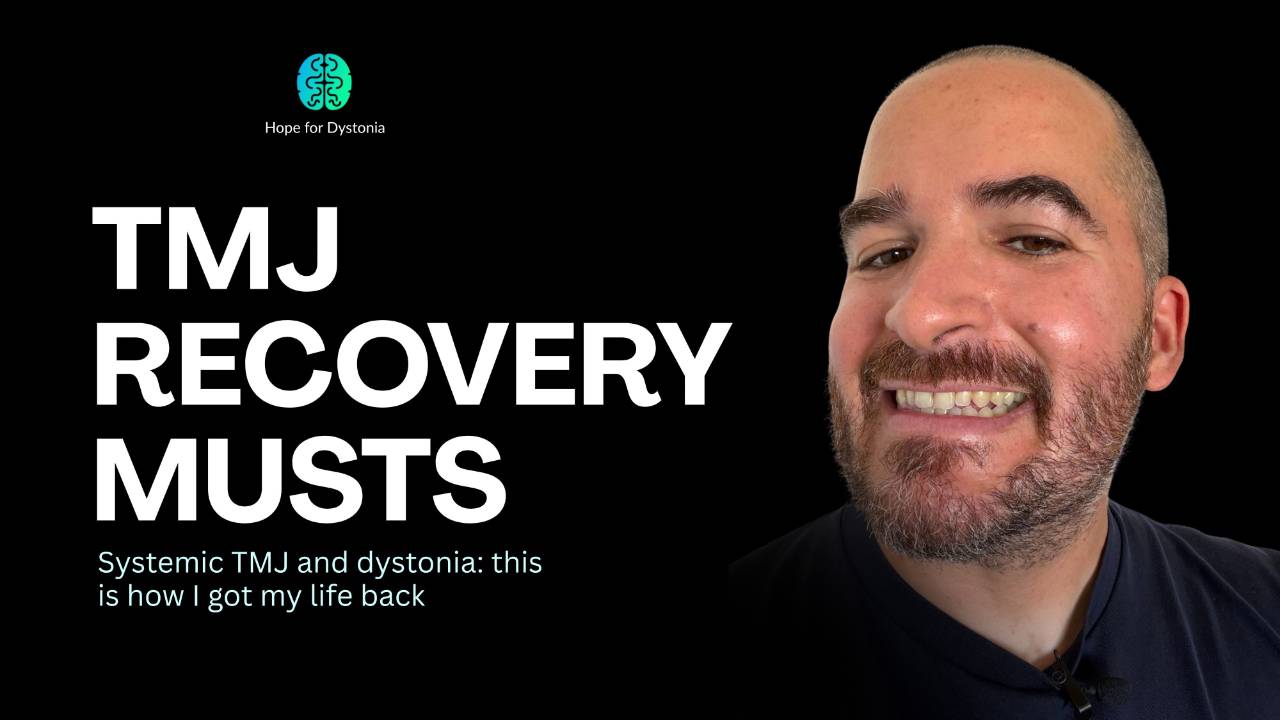
Systemic TMJ: Why It's a Nervous System Problem, Not an Engineering One
This article is based on a video from the Hope for Dystonia YouTube channel.
I made every mistake there is with this. I got the wrong appliances, saw the wrong practitioners, put my faith in the wrong people, and spent tens of thousands of dollars on solutions that didn't hold. It got so bad I could barely get out of bed, and it went on for years. Then I began to understand a few things, and I turned it around. If I did it, so can you.
Today I want to talk about something a lot of people discuss and very few actually understand: what I call systemic TMJ. Not just a jaw that clicks, but an imbalance in the way the jaw sits that shows up through the whole body: asymmetrical tension, shoulders and pelvis off-kilter, the whole body twisted like a handkerchief.
There are three things you absolutely need to know if this is relevant to you, whether you have a dystonia diagnosis or just came here for the TMJ. Keeping them in mind will change how you approach the whole problem, and stop you running in circles.
Watch the Full Video
Point One: This Is Not an Engineering Problem
This is the big one, and it's completely different from what you'll hear almost everywhere else. Systemic TMJ is not a problem you solve by figuring out the mechanics of how your teeth fit together, observed from the outside. There is a mechanical aspect to it, yes. But first and foremost, this is a nervous-system problem.
That single misunderstanding is what sends people in circles, from appliance to appliance, practitioner to practitioner, one failed treatment to the next. What's really happening is that people get stuck in patterns of guarding, in fight-or-flight or shutdown, with dysregulation deeply embedded in the nervous system. And from that dysregulated place, they go hunting for the perfect jaw position that will finally satisfy the nervous system.
But it can't work that way, and here's why: the position that makes the nervous system happy is one that reflects a state of regulation in the first place. You can't force your way to it from a braced, threatened state. The tension in the jaw is an expression of that threat state. The work is to move away from the tightening and cultivate regulation, and only then do things start to become clear.
And as the noise of the dysregulation quiets down, something else becomes possible: you can finally listen to the signals your body is sending. You stop needing an external savior to tell you where your jaw should be, and you start finding a better and better position yourself, one that makes your nervous system happier and happier. That sovereignty is the whole difference between healing and going in circles.
Point Two: It's Not a Jaw Problem Alone
This is not a teeth problem, and it's not a jaw project. It's systemic, which means it involves broader patterns of regulation and dysregulation across all twelve pairs of cranial nerves, not just the fifth cranial nerve in the jaw.
Those twelve pairs govern an enormous amount: autonomic regulation, sensing the environment, perceiving your body in space, and organizing the muscle tone in your jaw, your tongue, your neck, and more. To move forward in a way that fits your specific patterns, you have to understand what you're actually doing. Are you overusing one side of the jaw? One side of the tongue? Is your SCM stronger on one side than the other, and what about the scalenes and the trapezius?
You can map all of this. And that matters, because it means you stop doing generic exercises repeated mechanically, and start waking up what is specifically sleepy in your case, then integrating it into how you move, chew, and speak. I lost so much time on generic exercises. Once I understood there were specific things that needed reintegrating, and learned to target those, my recovery sped up enormously. You can't solve the jaw by focusing on the jaw alone.
Point Three: Give Yourself Time
Start with the expectation that this is not a one-off. It is not the thing where you fly to the savior in Korea, or the US, or Canada, who finds the perfect position and fixes you, and then you're done. I made all of those mistakes. And even when I got what looked like rapid relief, it was gone the moment the appliance changed or broke, or something shifted in my body.
That's because the body needs to adapt, in several ways. It needs to know the new position is safe and can be trusted. It needs to know how to get there on its own, not only through an appliance or a treatment it can't reproduce. And it needs neuroplasticity: enough time and repetition that the new position becomes the default rather than something you can only briefly access.
For many of us with systemic TMJ, the maladaptive patterning is more fundamental than, say, musician's dystonia, which can be specific to one trigger and one set of limbs. A lot of us grew up with these imbalances: certain muscles stronger from overuse, the cranium shifted by imbalanced forces, the upper cervical vertebrae misaligned. Those are baked into how the body grew, and they take time to improve. There will be ups and downs, because the brain is always tempted back to the old, well-practised pathways. But as long as you keep pointing yourself toward the newer, better balance, that's the balance you'll slowly learn.
What This Looks Like in Practice
In the Self-Healers Academy, we start by mapping the cranial nerves with precision, so you have a picture of all twelve pairs and understand what to stimulate, what to release, and what to repattern. Then there's a large library of repatterning practices, so you learn to wake up what's sleepy, let go of what's overused, and build the neuroplasticity to carry the new patterns through your day.
As you progress, there's a tool we call the Occlusal Adjustment Evaluation Grid, which helps you develop your own criteria to guide any work you do with a practitioner. So when you're in the dentist's chair getting an adjustment, you can actually evaluate its impact: Do I have better mobility in my neck? Greater ease when I stand and walk? Your criteria might involve your voice, your throat, your face, whatever is specific to you. The whole journey is centered on agency and sovereignty. Some people will still need a dentist for appliances or adjustments, but the essential thing is realizing you have the power to feel what's been forgotten and what's overused, and to learn a new way of inhabiting your head and neck.
The Real Message
I'm not asking you to believe a new method or trust a new solution that says do this, not that. I'm asking you to begin connecting with yourself and your nervous system, to find the agency and sovereignty that let you discover a new organization in your jaw and your whole body. I used to be stuck in bed, unable to speak or walk for more than a few minutes. Now I can chew whatever I want, take five-hour walks along the shore, and kayak, which for me is the clearest proof of how far I've come, because of how much stability in the jaw and neck it takes. I got my life back. The people in the testimonials got theirs back. If we did it, so can you.
Your Next Steps
Two free resources pick up exactly where this article leaves off:
1. The free workshop (October 4). A live cranial-nerve mapping practice — the very thing described here — whatever imbalance you have in your head, neck, or body.
2. The free Dystonia Recovery Kit. The foundational information I wish someone had handed me when I was going through the thick of it.
You can also book a time to speak, where we look at whether the Academy is genuinely a good fit for you. It isn't right for everyone, but when it is, it can change your life. Much love to you.
If I did it, so can you.