Meige Syndrome: 3 Things to Know About Facial Dystonia
Sep 28, 2026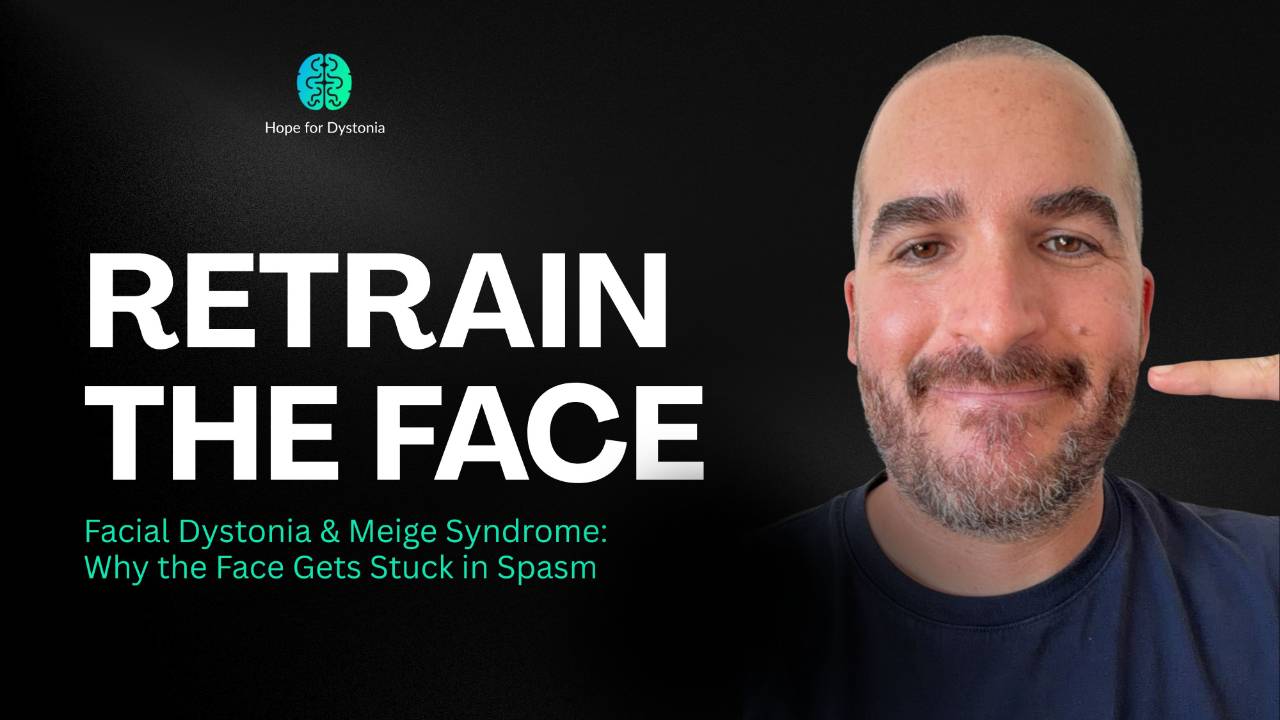
This article is based on a video from the Hope for Dystonia YouTube channel.
If you have dystonia that shows up in your face, your jaw, your eyes, this article is for you, whether or not you carry the specific label of Meige syndrome. I want to give you three crucial points that reframe the whole thing, and help you feel empowered to work with it in a targeted way, rather than running in circles looking for a savior. I got my life back this way, and so can you.
Meige syndrome, and involuntary movements or spasms in the face, can feel bewildering. But there's an order underneath it. These three points move from the most visible layer (the muscles) down to the deepest one (why the pattern is there at all), and the third is the one that makes the first two actually take hold.
Watch the Full Video
Point One: Cranial Nerve 7 Is Crucial
Cranial nerve seven is fundamental. It helps with taste on the tongue, with our facial expressions, and it's a key part of our social engagement system. When there's Meige syndrome or any spasm and trouble in the face, cranial nerve seven is a big part of what's happening, so learning to work with it is essential.
How do you start to understand what your seventh nerve is doing? Make funny faces, ideally in front of a mirror. Big ear-to-ear smiles, surprised expressions, pulling the corners of your mouth down like a five-year-old who didn't get ice cream. See where things move easily, where there are restrictions, and where involuntary movements happen in muscles you didn't intend to move. You're mapping what's sleepy and what's overactive.
But this is just the beginning. The obvious facial movements are only part of it. Also look at your sense of taste, especially how you taste sour things, lemon or vinegar, across your tongue. You might notice you taste less clearly on the edges, or more clearly on one side than the other. That map tells you important things. For example: "I taste clearly on the right, but the right side of my face feels sleepy when I smile, and when I wake up the sleepy side of the tongue, I suddenly get more access to the face." If your seventh nerve is giving you trouble with your eyes (blepharospasm), activating taste on the tongue can open up more access to the eyes. Working with the seventh nerve in the tongue can produce beautiful changes elsewhere, and bring balance to the whole ecosystem.
One more branch worth knowing: the seventh nerve also drives the platysma, the sheet of muscle at the front of the neck that tenses when you grimace. You'd be surprised how involved it is in facial dystonia, overfiring for some people, completely inaccessible for others. As you wake it up where it's sleepy, you stop overdoing things elsewhere. The whole game is balance, giving each branch of the seventh nerve the same attention and integration.
Point Two: Separate Cranial Nerve 7 from Cranial Nerve 5
Cranial nerve five is extremely relevant here too. It helps with chewing, with muscle tone in the jaw, and with facial sensation. Many people with dystonia, whether Meige syndrome, oromandibular dystonia, or any dystonia that starts in the head and neck, develop an association between nerve five and nerve seven. You've probably heard the phrase "what fires together wires together," and that's exactly what happens: somewhere along the way we learned that engaging nerve five means also engaging nerve seven, or vice versa. Before we know it, we're clenching our teeth hard when we smile, or something wants to clench when we open our mouth to speak or eat.
The work is to help your brain separate them, and you do it with sensory-motor retraining. In essence: give a clear sensory input to one nerve, something cold, or vibration, whatever feels good, so your brain really registers "that is nerve five." Then try to do the thing that's hard, and use the input to catch what you don't want to fire.
A concrete example: if you can't smile without clenching your jaw, start by just thinking about smiling, without actually smiling, while holding an ice pack near the clenching muscles of the jaw. The moment you feel tension come online, you catch it with the ice, giving your nervous system the message: "you don't have to fire this, it's separate, that's not what I'm trying to use." That creates the productive confusion that lets the nervous system update its algorithm, the set of predictions that currently insist "every time I smile I must also clench." You're giving the brain the chance to learn that it doesn't.
That's the essence, but it takes guidance, repetition, and support, which is exactly why the Academy is built to invest in you over time. And a caution: if you try this now and notice something, get excited, and then it doesn't stick, be patient with yourself. That's why the Academy runs six to twelve months. The brain needs a real progression of neuroplasticity, and it's completely normal for these things to be available only briefly at first.
Point Three: Create the Conditions for Neuroplasticity
This one is essential, because it's what lets points one and two actually take hold. Meige syndrome, and spasms in the face and neck, are about far more than learning something new with your muscles. Mostly, they're about a pattern of chronic guarding and chronic dysregulation, often learned specifically around self-expression and how we've learned to exist in the world.
Growing up, we learn what's safe and what isn't, and we adopt strategies to stay emotionally safe, to avoid being yelled at, or made fun of. One of those strategies is often to stay in a state of chronic activation, chronic fight-or-flight, continuously tightening and guarding to keep any danger inside our vigilance. Very often this hyper-vigilance is tied to social interaction, and this kind of developmental trauma can lead the symptoms to show up right in our social engagement system, in the seventh cranial nerve and the face. And if your spasms don't specifically show up around people, the principle still holds: there's a way we've learned to stay chronically tense and guarded.
This we can unlearn, and we unlearn it through self-compassion, through what I call Embodied Attachment Integration. That means working with the wounded parts of us that learned to stay guarded, and bringing them the love, care, and attunement they need, so those strategies feel less and less necessary. Not forcing the tension to relax, that never works, but giving those parts the conditions to feel, little by little, that the guarding is needed less and less. Then the nervous system can move at the speed of trust and slowly adopt a new way of being you, and that new way is what lets the cranial-nerve repatterning from points one and two actually stick.
The Real Message: You Are Not a Helpless Victim
There's a lot in here: cranial-nerve mapping, cranial-nerve repatterning, a taste of the exercise of catching the misfiring the moment it appears, and the foundations of Embodied Attachment Integration, understanding that the tension is something you learned in order to stay safe, and that you can unlearn it through love and compassion. All of it points to one thing: you can make sense of what's happening, and you can give your nervous system new inputs so it can learn to do something different. You are not a helpless victim. If I got my life back, and if the people you hear from in the testimonials did too, you can do this. You're not different from us. The brain is plastic, and your body wants to get better.
Your Next Steps
Three free (or nearly free) resources pick up exactly where this article leaves off:
1. The free workshop. A cranial-nerve mapping practice for trouble anywhere in the face, jaw, or eyes, done together with others walking a similar path.
2. The free Dystonia Recovery Kit. The information that changed my life once I understood and developed it.
3. A consultation call with me. We can go over your situation together and see whether the Self-Healers Academy could help. It's a nominal fee that you can apply toward the Academy if you choose to enroll and we both feel it's a good fit.
Download the free Recovery Kit → · or book a call with me →
A lot of people are suffering who don't need to be. The brain can learn, and your body wants to get better. You can do this. Much love to you, and I'll see you in whatever the next step is.
If I did it, so can you.