Dystonia and Your Childhood: The Attachment Roots of Chronic Dysregulation
Oct 08, 2026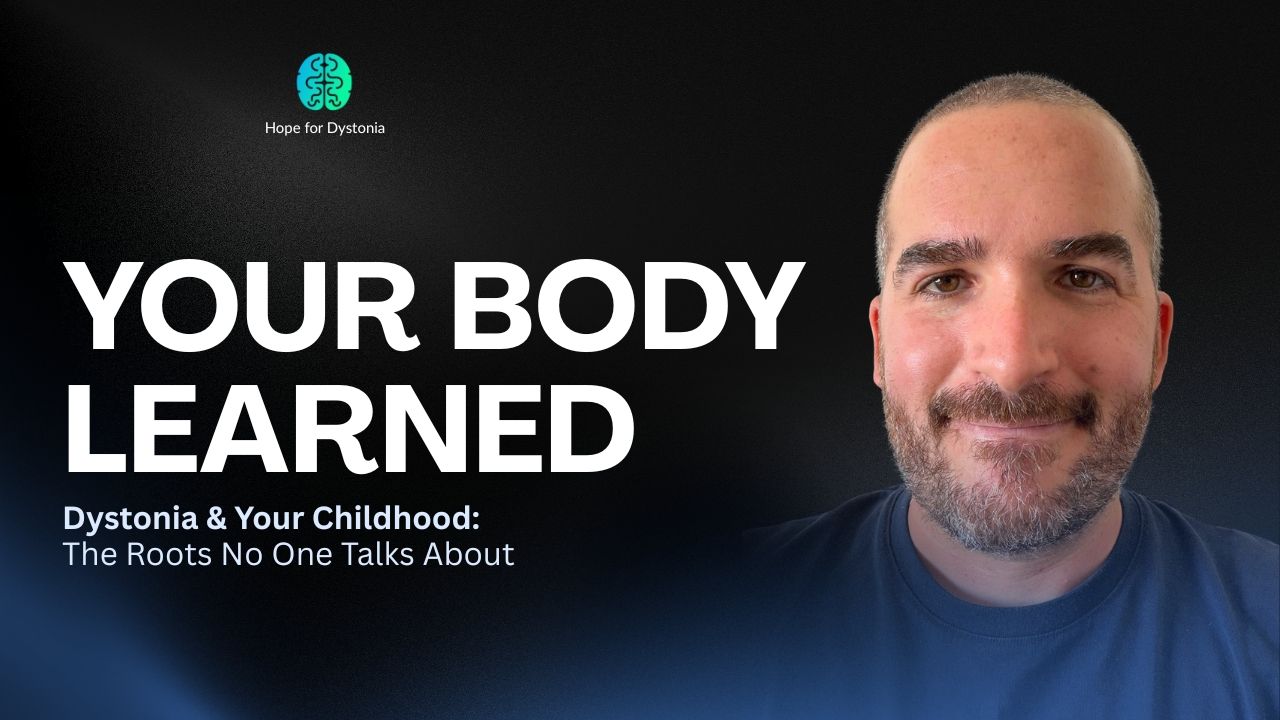
This article is based on a video from the Hope for Dystonia YouTube channel.
For years I believed my dystonia began with a dental problem. That was part of the story — but only part. The deeper I went into my own recovery, the more clearly I saw that the dental issue had landed on a nervous system that was already bracing: one that had learned, long before any accident, to stay tense simply in order to feel safe. A great deal of that bracing traced all the way back to childhood.
This is a loaded topic for many of us. Some people know exactly what wounding they carry. Others don’t know they carry any at all, and can’t understand why they’ve adopted certain patterns of chronic protection, guarding and dysregulation. Wherever you are on that spectrum, you are welcome here, and you belong here.
In this article I want to do two things: shed light on how these patterns form, and give you a concrete sense of what you can actually do next to begin turning them around. Let me start with a little about where I’m coming from.
Watch the Full Video
Where This Work Comes From
I’ve been trained and certified as a mindfulness meditation teacher, and I’ve been fortunate to study in several frameworks that do an extraordinary job of addressing the meeting point between Western psychology and spiritual practice — drawing on Theravada and Indo-Tibetan Buddhism, Jewish Kabbalistic approaches, and the psychology of attachment. The question at the heart of all of it is a simple one: how can learning to connect to the love that is always loving us help us heal the wounds we carry, and live more empowered, more at ease in our daily lives?
You’ve heard me speak often about cranial nerves and dystonia. But the cranial nerves are really just the specific entry point. This question — about love, wounding and the nervous system — is the bigger one underneath it all. And one word makes everything else clearer, so I want to define it before we go any further: attachment.
What “Attachment” Actually Means
Attachment, in this context, refers to the process by which we learn to organise our nervous systems through our relationships with our primary caretakers growing up.
When our parents are able to give us certain experiences consistently — safety, attunement, delight, encouragement, soothing — we can internalise those experiences and build a secure base within ourselves. We learn to meet our fundamental psychological needs while staying regulated. I can think of myself as a good person without going crazy to prove it. I can feel safe without staying permanently on guard.
When we don’t get enough of those experiences, consistently enough, something else happens. We learn to stay dysregulated in order to meet those same fundamental needs for safety, connection and self-esteem. We step outside what’s called the window of regulation — the range in which the nervous system can move between activity and genuine rest — and we learn to live outside it, sometimes for most of our lives.
Point One: Dystonia Is Often a Pattern We Learned
More often than not, dystonia is a pattern of dysregulation that emerged — among other things — because we learned to stay dysregulated in order to meet our fundamental psychological needs, often as children.
What does that look like in a life? Usually it takes one of a few familiar shapes:
- Flight — we can’t settle. We jump from one thing to the next, trying to get everything done, because somewhere we believe we have to earn our keep, earn approval, prove we’re worthy of love and care.
- Fight — we live in constant, excessive activation. We read everything as a battle, we find ourselves aggressive, and we don’t allow ourselves to relax.
- Freeze — we make ourselves small and avoid life.
- Fawn — we try to make everyone else happy at our own expense, and paint ourselves into corners that quietly make us miserable.
Eventually that way of living leads to a life our bodies beg us to change — and dystonia can become a symptom of exactly that plea.
Here’s the important nuance: this pattern of chronic dysregulation usually doesn’t produce dystonia all on its own. More often it’s the substrate — the ground over which additional layers of injury, trauma and maladaptive learning get added.
Picture it this way. Say I’ve carried a pattern of chronic dysregulation since childhood — I may not even be aware of it, I just end up tense because of it. Then one day I have some orthodontic treatment or a dental accident, and my jaw ends up misaligned, my bite changes, my condyles no longer sit in the temporomandibular joints the way they used to. Suddenly the nervous system is receiving asymmetrical inputs, and the tension that was there all along — but symmetrical — starts to look lopsided. That’s when symptoms of dystonia can become visible.
Or the same substrate meets a big life event — a major loss, a move, something that exceeds the nervous system’s capacity to keep it all together. The metaphorical foot goes all the way down on the gas, and after a period of that, visible symptoms can emerge.
This is one very common factor behind dystonia, and it’s why things like C-PTSD, developmental trauma and high ACE (adverse childhood experience) scores so often point in this same direction. And it’s worth saying plainly: not everyone recognises that they carry this kind of wounding. For some of us it’s obvious. For others, it’s genuinely hard to see that we had it tough at all.
Point Two: This Is Nobody’s Fault — and It Is Your Responsibility
This may be nobody’s fault. Even where parents genuinely didn’t do their best — and sometimes that’s the honest truth, and it’s appropriate to name it — they usually behaved the way they knew how, shaped by how they themselves grew up.
And very often our parents did do their best, and still couldn’t give us what we needed, simply because they never received it themselves and didn’t know what it was. Sometimes we have parents who were wonderful by every reasonable measure, and yet, in terms of what we actually experienced as children, we didn’t get enough of what we needed — enough safety, soothing, delight in our essence, the sense of being valued for who we are, attunement, being truly seen and understood, encouragement to be exactly who and what we are. Sometimes those things just weren’t there consistently enough. This is intergenerational trauma, passed down the line.
So responsibility here does not mean fault. It doesn’t mean “my nervous system learned this, therefore I did this to myself and I should have known better.” You did the best you could with what you knew. And now, as an adult, your body may be asking you to change something — to meet the pain and the wounding within, and to create a new way of being you.
That’s why this message of responsibility is actually an empowering one. You really can respond differently to what comes up inside you. And once you learn to respond differently to those old patterns of trauma and chronic dysregulation, you gain the power to build new ones — ways of being that keep you inside your window of regulation and let you meet what life throws at you with far more resilience.
Point Three: Teaching the Nervous System It’s Safe to Let Go
You can shift your patterns of chronic guarding and protection — if you help the parts of you that learned those patterns to trust that they’re no longer necessary. How? It helps to think in three depths of change.
- The first depth says: I’ll stop dystonia by yelling at my body — forcing a new pattern, going rigid, drilling the “correct” posture, suppressing this or that muscle. It works for a tiny moment, and then the instant you stop watching, the pattern returns.
- The second depth says: I’ll teach myself to do something else instead — a new movement in the neck, a set of exercises. For a reasonably simple, uncomplicated case, this can lead to some genuinely good, adaptive learning. But when a new stressor comes along and your balance is challenged, it’s easy to default straight back to the old guarding patterns.
- The third depth — the one I want to point you toward — says: I want my nervous system to know the old pattern isn’t necessary anymore, because it has experienced enough of a new pattern that actually gives it what it was looking for all along.
Think of smoking. If you learned to smoke in social situations because it helped you feel calm and at ease, the only way to truly stop — without being pulled back the moment things get hard — is to meet the pain underneath it: the shame, the low self-esteem, whatever it is, and to give that part of you the love, the attention, the mirroring, the delight in your essence it’s been reaching for. Once you can remind that part of you that you are good enough and have nothing to prove, everything changes, because you no longer need the shortcut. (And yes — I’ve done exactly this myself.)
It’s the same with dystonia. We work with those very old patterns, the ones so often learned in childhood through the attachment process, and we help the nervous system discover that there is an alternative — giving it enough of the new experience that it comes to trust that new way of being you. And once the nervous system trusts it, more and more becomes possible in terms of what you can learn to do with the affected parts of the body.
This Is Embodied Attachment Integration
This is the work I call Embodied Attachment Integration, and it’s at the heart of the Hope for Dystonia method and the Self-Healers Academy. In plain terms, it’s the work of bringing love — and those missing early experiences — to ourselves as adults, and then translating them into new sensory-motor patterns, very specifically when it comes to dystonia. It’s about repatterning things at the root, which is why it can take you well beyond what you may have tried elsewhere.
I want to be clear about one thing: this approach is not a substitute for psychotherapy. It’s a way to empower you to work with your own patterns — to build practices that gently move you away from what keeps you dysregulated and toward more consistent regulation. That kind of work takes good guidance, the right container, the right community, the right practices and meditations, and real support. That’s exactly what the Academy is built to offer.
If I Did It, So Can You
Once we teach the nervous system that it’s okay to let go of chronic guarding and protection, all kinds of possibilities open up, and it becomes far easier to learn to do new things with the affected parts of the body. I lived through severe dystonia, and so much of my recovery came from precisely this — meeting the old patterns with understanding rather than force, and giving my system a genuine chance to trust something new. If I did it, and if the people in the testimonials did it, so can you.
Your Next Steps
There are three ways to pick up exactly where this article leaves off:
1. The free Dystonia Recovery Kit. The foundational information I wish someone had handed me when I was in the thick of it.
2. The free workshop. Our upcoming live workshop goes deep into this very topic — dystonia and your childhood — and how to begin repatterning it.
3. A conversation with me. You can book a time to speak with me, so we can look at how these patterns play out for you specifically and find your next steps together.
Want to go deeper live? Save your spot in the free workshop →
Prefer to talk it through? Book a time to speak with me →
No cost, no catch — just a new way of understanding your body and your story. Much love to you — you can do this.
If I did it, so can you.