The 3 Cranial Nerves That Matter Most for Dystonia Recovery
Sep 06, 2026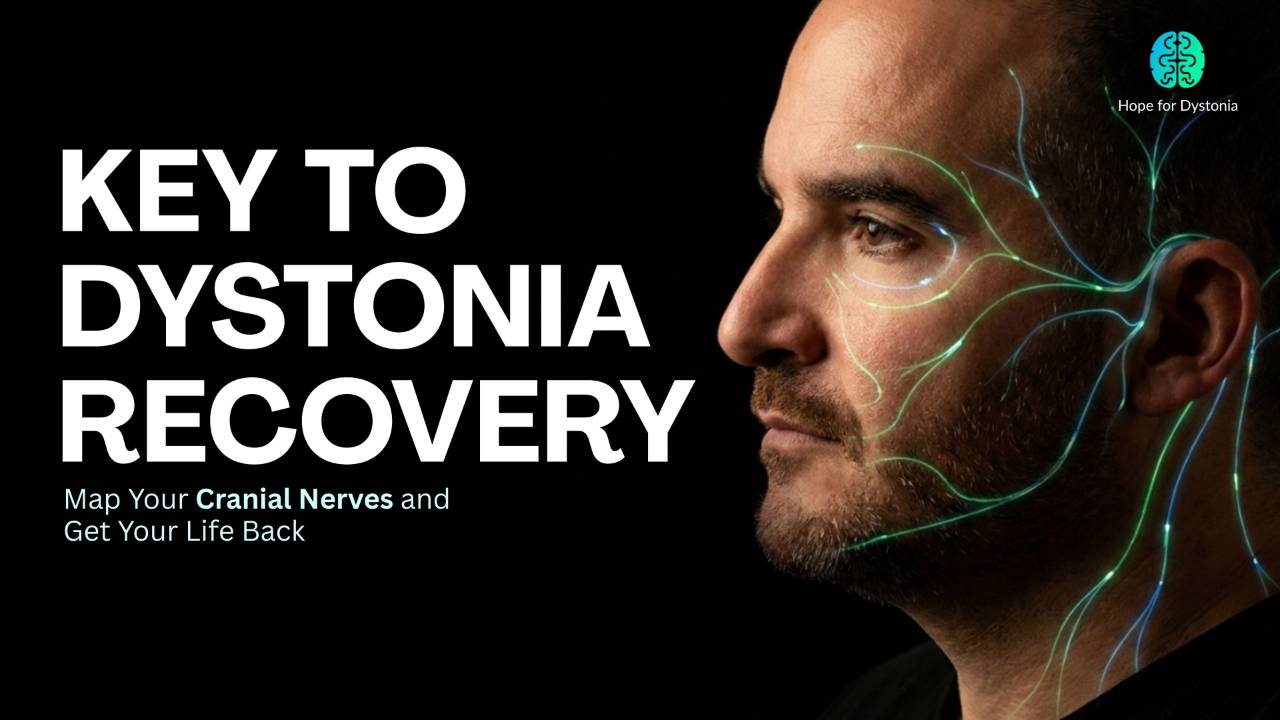
This article is based on a video from the Hope for Dystonia YouTube channel.
When my dystonia was at its worst, I had trigeminal neuralgia — intense pain in the fifth cranial nerve — and I could only really use the right side of my mouth. The left side just got dragged along. I did not think that would ever change. It did. And a large part of how it changed was learning to understand my cranial nerves.
If you have dystonia in your head, face, or neck — or generalised in your body — your cranial nerves are deeply involved. We have twelve pairs of them, and they each do something unique. They shape how you perceive yourself, how you sense your body in space, how you regulate in response to what you see, and much more.
When dystonia is present, it means we have learned to overuse certain cranial nerves and underuse others. The good news is that this is learned — and what is learned can be remapped. This article walks through the three cranial nerves you most need to know, with a small hands-on experiment for each, so you can begin to relate to your own nervous system in a new way.
Watch the Full Video
▶ Watch: The 3 Cranial Nerves That Matter Most for Dystonia Recovery
First, Why Befriending Your Nervous System Changes Everything
Before we get into the specific nerves, the underlying idea is this: when you befriend your nervous system rather than fight it, you can begin to understand what is actually happening. You can respond in new ways. You can gently stimulate what has gone sleepy, let go of what is overused, and little by little build a new way of inhabiting your own cranial nerves. That shift — from fighting the symptom to understanding the pattern — is where recovery starts.
If you are on a healing journey, the single most useful first step is the free Dystonia Recovery Kit — the information I wish someone had shared with me when I was in the thick of it. Get it free here.
Cranial Nerve 5: The Jaw and Face
The fifth cranial nerve lives mainly in your jaw and face. It helps you chew, speak, and regulate the muscle tone around your jaw and the whole apparatus of mastication. But here is the part that matters for dystonia: you also fire cranial nerve five when you are tense and bracing for danger. For many of us, after years of living in tension, anticipation and fear, that bracing has become a chronic habit.
We also don't fire it symmetrically. Many people with dystonia have learned to chew only on one side — maybe from a missing tooth, an orthodontic issue, or pain. When mine was severe, I lived almost entirely on the right side of my mouth.
Try this now
Gently bite down on your teeth and palpate the muscles around your jaw, your cheeks, your TMJs, and up into the temporal area above. Feel for asymmetry. Is one side bigger, firmer, stronger, maybe even warmer to the touch? There is a good chance that is your overused, hypertonic side. And if cranial nerve five is asymmetrical, the other cranial nerves connecting to the brainstem are likely doing their own acrobatics to help you keep your balance. Make a mental note of what you find.
Cranial Nerve 7: Facial Expression and the Eyes
The seventh cranial nerve lives in your face, tongue and neck. One of its jobs is facial expression and communication — smiling, looking surprised or sad. It also controls blinking and the opening and closing of your eyes. So if you have blepharospasm or Meige syndrome, cranial nerve seven is very likely involved.
Try this now
Produce your biggest ear-to-ear smile, as wide as you can, then palpate again. Is one side working harder, pulling higher, firmer? Now try a surprised face, then a sad one, pulling the corners of your mouth down. Notice whether both sides are equally available, or whether one is easier than the other. And if you feel heaviness or tension around the eyes — something squeezing them closed — that is an important signal about cranial nerve seven, and one of the patterns of protection that shows up with blepharospasm.
These experiments are the tip of the iceberg. The free Recovery Kit gives you the foundations to go further — download it free here.
Cranial Nerve 11: The Neck
The eleventh cranial nerve lives in your neck and innervates its largest muscles — it helps you turn your head, tilt it back, and more. With cervical dystonia — or dystonia in the head and neck without that specific label — we often carry far more tension on one side than the other.
Try this now
Palpate your neck and find where the tension lives. Keep it simple: divide the neck into sections — front, back, left, right — and notice which sections hold the most tension. You will likely find the tension corresponds to restrictions in your movement, and (spoiler) also in your eyes, and perhaps connects back to what you felt in your jaw. The neck holds overlapping patterns — retrocollis, laterocollis, torticollis — which can layer over each other, so it may not be tidy. You don't have to map it perfectly right now. Just notice that there are patterns, and that they are telling you what you use more and what you use less.
Then comes the real invitation: if these are the muscles you overuse, what are the ones you have been forgetting? Give your sleepy sides a little massage, try to engage those muscles, and see if you can bring some aliveness to them, even for a few seconds. That is the beginning of a taste of freedom.
The Real Gift: A Map That's Yours
This is the gift of the cranial nerves. When you map them for yourself, you end up with a picture of your own system — unique to you — so you can do work that is targeted to you. You can let go of old patterns, flirt with new ones, find newer and newer ways to engage them, and ultimately embody those new patterns as your default. You are recruiting things that were not available to you before.
If I Did It, So Can You
The nervous system can do incredible things when we give it the right conditions and a genuine chance. I lived through severe dystonia and trigeminal neuralgia, and so much of my recovery came from exactly this kind of patient, curious mapping. If I did it, and if the people in the testimonials did it, so can you.
Your Next Steps
There are two free resources that pick up exactly where this article leaves off:
- The free Dystonia Recovery Kit. The foundational information I wish someone had handed me when I was in the thick of it.
- The free workshop. Our upcoming live workshop goes much deeper into the cranial nerves — the very topic of this article — and how to map and rewire them.
Start here: Download the free Dystonia Recovery Kit →
No cost, no catch — just a new way of understanding your body. Much love to you, and I hope to see you in the workshop.
If I did it, so can you.