Why Setbacks in Dystonia Recovery Aren't Failure: Turning Regression Into Growth | Hope for Dystonia
Apr 28, 2026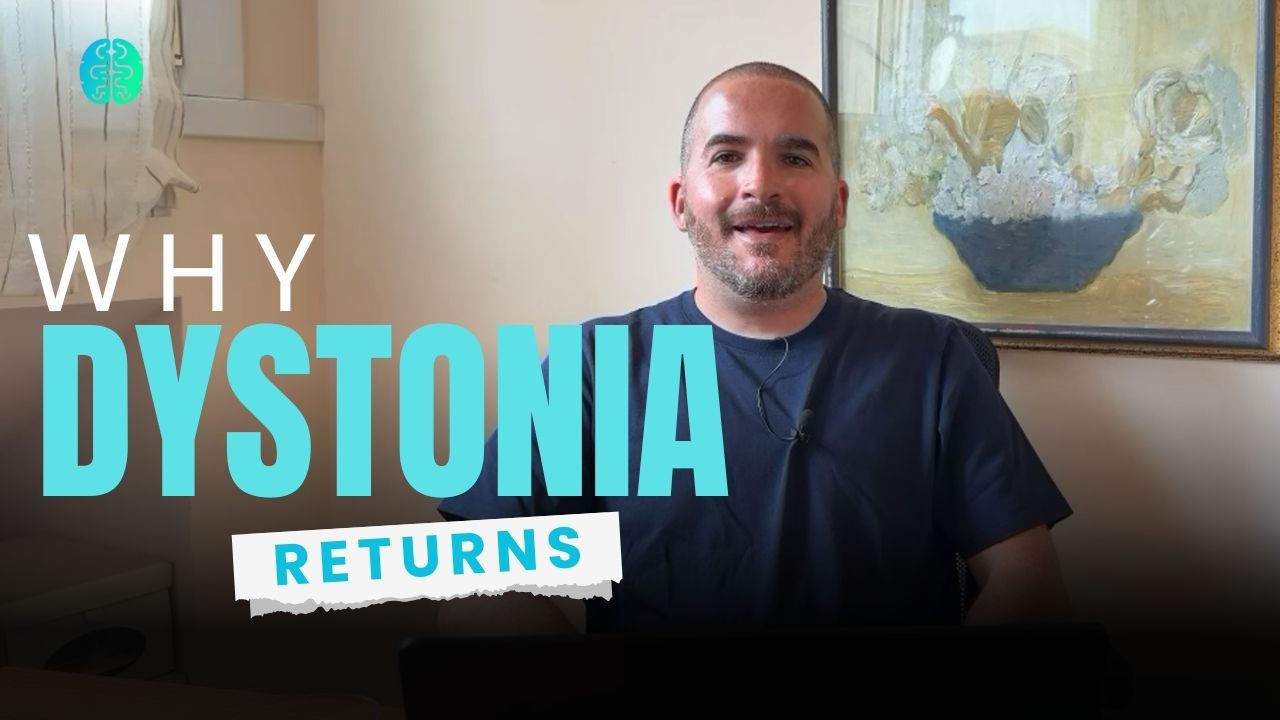
This article is based on a video originally published on the Hope for Dystonia YouTube channel.
Today I want to talk to you about something that is very common on a recovery journey from dystonia: the inevitable ups and downs, and what to make of the moments of seeming regression.
We've all experienced moments when things actually begin to feel better—maybe because of an exercise we found online, some sort of physical therapy, or a new appliance for those of us with dystonia in the head and neck. Things seem to get better.
And yet it doesn't last.
There is a lot of really important information and concepts to understand around those moments—if you want to turn them from seeming moments of defeat into moments of growth.
Watch the Full Video
When Dystonia Comes Back — It's Not Failure. Here's What It Actually Is.―
The Common Experience: Progress That Doesn't Stick
One of the most common things I encounter with clients is this pattern:
Initially, they begin to feel agency. They understand that they can provide new inputs to their nervous systems. They begin to inhabit new patterns in their bodies. They begin to use their muscles differently. They find regulation more reliably and more often.
That is exciting, isn't it?
Because all of a sudden, we begin to feel: "Yes, I can have an impact. I have influence over how my nervous system organizes."
And then we notice something discouraging.
The nervous system is not able to hold those states we touch into. They don't become the default instantaneously.
Here's what I want you to understand: That is perfectly understandable. It is not a sign of failure. It is a sign of integration that needs to happen.
The Snow-Covered Mountain: Understanding Why This Happens
You may have heard me share the metaphor of the snow-covered mountain in other videos on the Hope for Dystonia YouTube channel. If you haven't checked out the videos on neuroplasticity, I recommend you do—that information is invaluable and transformative for your healing journey.
But let me share one aspect of all that here, because it's crucial for understanding what we're talking about.
The Brain as a Snow-Covered Mountain
The brain is like a snow-covered mountain.
The movements we make, the ways we think, the ways we behave, the ways we organize our muscle tone and the nervous system in general—all of these are like skiers.
And the more a skier goes down a certain slope, the deeper the grooves become.
If I have lots of skiers doing the same thing, the grooves become very deep. Then the next skier that comes has a really hard time escaping those grooves.
Maladaptive Neuroplasticity: How Deep Grooves Form
That is how neuroplasticity works. When we have dystonia, we've been through a process of maladaptive neuroplasticity. We've learned something that doesn't actually help—but that seems to make sense when we're doing it.
And that something is learned. It is reinforced.
For example:
If I have an imbalance in my jaw and vertebrae, and something in my nervous system at a certain point has a hard time managing that imbalance, the nervous system under stress may default to a pattern of cervical dystonia.
That's an example of how certain inputs—in the jaw, in the vertebrae—have perhaps for a long time been telling the brain: "Hey, you need to favor this side over the other."
This becomes learned and becomes, over time, more and more difficult to escape.
The Attractor State
What happens with these skiers going down the same slope over and over again is that they reinforce things. That reinforcement creates a baseline.
And that baseline becomes the attractor state of the nervous system.
So I default to doing that thing. That's where the nervous system naturally goes—because the grooves are deep, familiar, and feel "safe" even when they cause suffering.
When You're Learning New Patterns: Fresh Snow
Now, if you're a self-healer in the Academy, for example, and you're learning how to scan your cranial nerves, learning how to work with the wounded parts of you so they don't lead you to live in constant dysregulation—learning to connect to safety and self-esteem—what you're actually doing is:
Helping your skiers go down a different side of the mountain. A new slope.
But the snow there is all fresh.
You have to chart a path through uncharted territory. And when you come back to this new slope once again, you're not too sure where to go—because the grooves are not that deep.
You have to do some work there integrating.
Why We Default Back Under Stress
Sometimes you're going to be able to go down this new slope. But sometimes:
- You're under stress
- There are lots of people around
- You're emotionally dealing with something important
- You didn't sleep enough
- Your boss is around and you get nervous
Whatever the case may be—at times you're not going to be able to go back to this new slope.
You're going to default to the usual one. That attractor state, that baseline, those deep grooves end up being where you go—just because it's hard to choose the new slope at that point.
The Crucial Reframe: Not Failure, But Integration
Here's the important thing I want you to learn from this video:
When you go down the old slope because you were stressed, or in some way it just didn't happen—when you weren't able to do the new thing—that is not a moment of failure.
That is a moment of integration.
That is a time when the nervous system said:
"Hey, the conditions here are not right for me to try on something that still feels uncertain."
"And so what I'm asking you to do is to help me create the conditions for this to be possible—for me to be able to go down that new slope, to do the new thing, to use my neck differently, my hand differently."
Regression as Information
It's an opportunity.
It's an opportunity that tells you: "These are the things you need at this point in order to choose the new slope."
When you're able to create those conditions, then you're able to slowly go back to the new pattern.
But that work—recognizing what conditions need to be present, and the ways in which they were not present when you defaulted to the old slope—that work is the heart of recovery.
What the "Conditions" Actually Look Like
Because you'll see, for example:
- "When I'm in social situations, all of this is a lot harder."
- "When my boss is around, I get all nervous."
- "I tend to overwork myself and have a hard time sleeping enough—and when I don't sleep enough, my nervous system defaults to survival patterns."
Recognizing all of this is crucial.
Because as you recognize these inputs, these patterns, these habits, you're able to do the work that actually creates change.
Working With the Wounded Parts
And that is such a key part of the Academy—namely, working with the wounded parts of you that react to life with patterns of dysregulation, with patterns of guarding, with dystonia.
The work is a work of deep, precise self-compassion.
That is the heart of the Academy—really helping you surgically go in and find where the pain is, so that you can bring love right where it's needed.
It seems simple, but it takes:
- Introspection
- Guidance
- Help
- A community
It takes what the community in the Hope for Dystonia Self-Healers Academy is able to give you. It is built for this.
What Happens When You Bring Love Where It's Needed
Once we're able to bring that love where it's needed, then the conditions to choose the new slope become more and more easily available.
The attractor state, the deep grooves, become the ones that we choose—the ones that support our well-being, our symmetry in the body, our homeostasis.
The new pattern starts to become the default.
Not because you forced it. Not because you tried harder. But because the conditions that were causing you to default to the old pattern have been addressed with compassion and care.
Practical Framework: When Setbacks Happen
Here's how to work with moments of seeming regression:
Step 1: Recognize It's Not Failure
When you default to the old pattern, remind yourself: "This is not failure. This is integration. This is information."
Step 2: Get Curious About Conditions
Ask yourself: "What conditions were present (or absent) that made it hard to choose the new slope?"
Common conditions that trigger defaulting:
- Stress (work, relationships, life events)
- Social situations
- Specific people (boss, family members)
- Sleep deprivation
- Emotional overwhelm
- Physical exhaustion
- Feeling unsafe or judged
Step 3: Work With What You Find
This is where the deeper work comes in:
- What wounded part reacted to that situation?
- What pattern of dysregulation or guarding showed up?
- What does that part need to feel safe enough to try something new?
Step 4: Bring Precise Self-Compassion
Go surgically to where the pain is. Bring love right where it's needed. This isn't vague positivity—it's targeted, deep compassion for the specific parts that are struggling.
Step 5: Create the Conditions
Work on building the conditions that allow you to choose the new slope more reliably:
- Address the wounded parts that react to certain triggers
- Build your capacity for regulation under stress
- Develop your internal sense of safety and self-esteem
- Connect with support and community
The Longer View: How Recovery Actually Works
Recovery isn't a straight line from "dystonic" to "recovered."
It's a process of:
- Touching into new patterns — Experiencing moments where you can use your body differently, feel regulation, inhabit new ways of being
- Defaulting back under certain conditions — Not because you failed, but because the grooves aren't deep enough yet and the conditions weren't right
- Learning from the default — Understanding what conditions trigger the old pattern
- Addressing those conditions — Working with the wounded parts, building safety, creating the conditions for change
- Choosing the new slope more reliably — As the conditions improve, the new pattern becomes more accessible
- Deepening the new grooves — Over time, the new pattern becomes the attractor state
This is how neuroplasticity actually works. Not instant transformation, but gradual deepening of new patterns while compassionately addressing what pulls you back to the old ones.
Why This Reframe Changes Everything
When you understand that setbacks are moments of integration rather than failure, everything shifts:
Instead of discouragement, you feel curiosity: "What can I learn from this?"
Instead of self-criticism, you bring compassion: "My nervous system is asking for something."
Instead of giving up, you engage more deeply: "This is showing me what needs to be addressed."
Instead of trying harder, you work smarter: "I need to create better conditions."
This reframe transforms the recovery journey from a frustrating battle against your body into a collaborative process of understanding and supporting your nervous system.
Your Next Step: The Recovery Roadmap
If this understanding of setbacks as integration resonates—if you're ready to learn what conditions your nervous system needs to choose new patterns—we invite you to download the Hope for Dystonia Recovery Roadmap.
This free resource provides:
- The complete framework for understanding neuroplasticity in dystonia
- How to work with the wounded parts that trigger dysregulation
- The role of self-compassion in creating lasting change
- Introduction to the Self-Healers Academy community
- Tools for recognizing and creating the conditions for recovery
Download Your Free Recovery Roadmap →
This is life-changing information—the kind that empowers you to turn moments of seeming defeat into moments of growth.
Related Resources
If this topic has been interesting to you, you may also like the videos on:
- The Three Stages of Neuroplasticity — Understanding the flirting, deepening, and embodiment phases
- Neuroplasticity in General — How learned patterns work and how to change them
- Working with Wounded Parts — The deep self-compassion work that creates lasting change
These can be a great next step in understanding how recovery actually works.
Final Thoughts: Not Failure—Integration
The inevitable ups and downs of dystonia recovery aren't signs that nothing is working.
They're signs that integration is happening.
Every time you default to the old pattern, your nervous system is giving you information: "These are the conditions I need to try something new. Help me create them."
When you respond with curiosity and compassion rather than frustration and self-criticism, you transform setbacks into the very material of recovery.
The grooves on the old slope are deep. That's okay. With the right conditions, the right support, and the right understanding, you can deepen new grooves—grooves that support well-being, symmetry, and regulation.
Not by trying harder. By creating conditions. By bringing love where it's needed. By working with what is actually there.
That's the heart of recovery. And it's absolutely possible for you.
Ready to transform your setbacks into moments of growth? Download the free Hope for Dystonia Recovery Roadmap and discover the framework that makes lasting change possible.